ADHD Cleaning Hacks
The hacks below are the ones that survive contact with real ADHD households — not productivity theater, just mechanics that work with an interest-based nervous system instead of against it. Each one names the problem it solves, because a hack without its problem is just a slogan.
Starting hacks
Body doubling. The single most reliable hack in the ADHD toolkit: clean while someone else is present, in person or on a video call. The task did not change; the accountability mirror did. No willing friend? "Cleaning with me" videos exist precisely for this.
The ten-minute treaty. You are not cleaning the kitchen. You are cleaning for ten minutes, and when the timer rings you may stop with honor. Most of the time the start was the whole problem — but the exit ramp is what makes starting feel safe, so keep the promise even when you are on a roll.
First-surface rule. Never begin with a decision. Begin with the surface that annoys you most visible from where you are sitting. The planner's room rituals are built on this — start at the sink, start with the bed, start where the eyes go.
Momentum hacks
The doom pile treaty. A doom pile (pile of undecided objects) is not cleaned, it is negotiated. The treaty: the pile gets one box and one appointment with your future self. Sorting a pile is a project; boxing a pile is two minutes. Future-you opens the box on a high-energy day, or in six months — both are valid.
The 5-5-5 rule. Five things to put away, five things to throw away, five things to give away. It turns "tidy the living room" into fifteen discrete, countable wins — and counting is the dopamine delivery mechanism.
The 10-3 rule. Ten minutes of work, three minutes of rest, repeat while it lasts. The rest is part of the method, not a reward you have to earn — ADHD focus burns hot, and scheduled cooling keeps it from torching the whole session.
Environment hacks
Make the timer the bad guy. "The timer said we stop" is a sentence that prevents both overtime burnout and the guilt spiral. You and the timer are coworkers; it does the deciding, you do the wiping.
Baskets everywhere. ADHD homes do not fail at organizing; they fail at the distance between the object and its home. A basket in every room shrinks that distance to zero — put-away becomes tossing, and tossing is executable.
Photograph the before. ADHD memory erases progress the moment it is made. A before photo turns "nothing changed today" into a two-image comparison your brain cannot argue with. This is also why the timer and the progress bar exist — visible evidence is the fuel.
What if I try these and nothing works today?
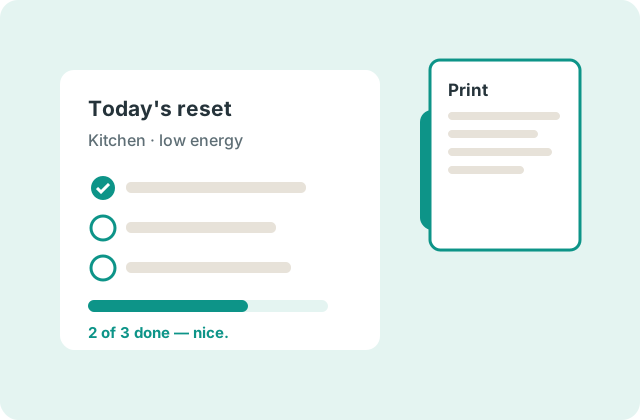
Then today was a low-energy day, and the planner's low mode exists precisely for it: sink, trash, one surface. Executing three small steps on a bad day protects the habit for the good ones. That is not a consolation prize — it is the actual skill.
Are these a replacement for treatment?
No. These are household mechanics, not therapy. They work alongside treatment, not instead of it.
Which hack should I try first?
The ten-minute treaty with the homepage timer. It needs no other person, no equipment, and it hands you a legitimate stopping point — which is the part most hacks forget to build.